
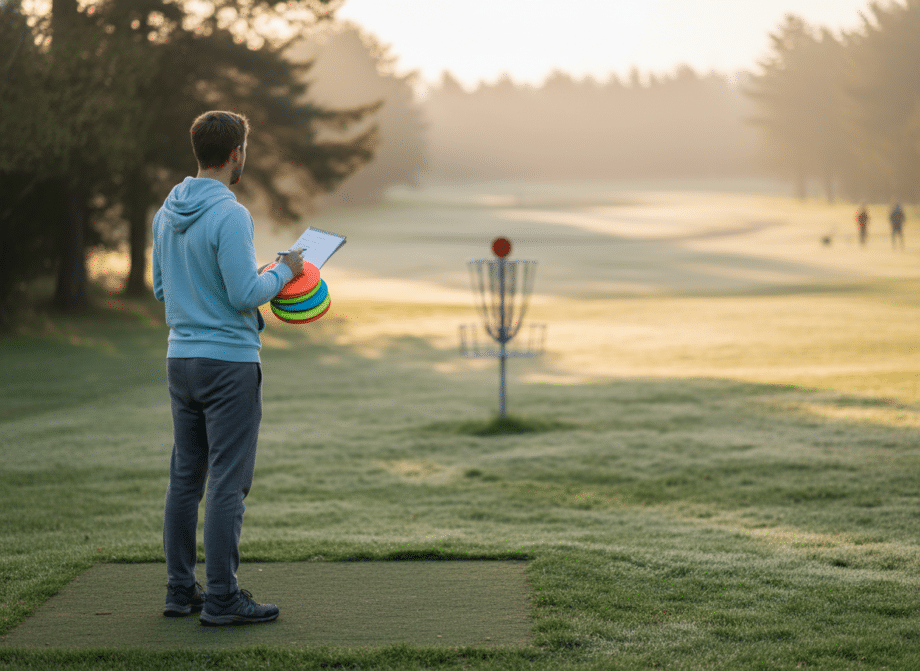
Setting Goals and Tracking Progress in Disc Golf (Without Overcomplicating It)
If you’re new to disc golf (or you play casually and just want to feel more consistent), setting a few simple goals can make the game way more fun. The trick is keeping your goals realistic, easy to measure, and focused on what actually helps you improve: cleaner throws, smarter disc choices, and more confidence on the course.
In this guide, we’ll walk through beginner-friendly disc golf goals and a simple way to track progress—no fancy apps required.
Why Goals Matter (Especially for Beginners)
Most new players judge progress by one thing: score. But early on, your score can bounce around a lot depending on the course, the wind, and even how crowded the tee pads are.
Good goals give you “wins” you can control—like throwing straighter, reducing big mistakes, and learning which discs you trust. That’s how you build momentum.
Start With the Right Kind of Goals
The best disc golf goals are specific and trackable. Instead of “get better,” pick something you can measure in a round or two.
H3: Outcome goals vs. process goals
Outcome goals are results (like your total score). Process goals are the actions that lead to better results (like hitting the fairway more often).
For beginners, process goals usually work better because they’re less frustrating and easier to improve quickly.
Examples of outcome goals
- Finish a round under a certain score on your local course
- Get your first par on a specific hole
- Reduce your “blow-up holes” (double bogeys and worse)
Examples of process goals (beginner-friendly)
- Hit the fairway (or landing zone) on 6 holes today
- Keep your drives in bounds on every hole
- Use a smooth, controlled throw instead of throwing as hard as possible
- Commit to one putting routine and use it every putt
Pick 1–3 Goals Per Round (That’s It)
If you try to fix everything at once, you’ll feel scattered. A simple approach:
- 1 goal for driving
- 1 goal for approach shots
- 1 goal for putting
Sample “simple round goals” for casual players
- Driving: Throw 70% power and focus on a clean release
- Approach: Aim for the center of the fairway, not the pin
- Putting: Use the same stance and routine every time
Track Progress With a Simple Scorecard System
You don’t need a spreadsheet to improve. You just need a consistent way to notice patterns.
Use 3 quick stats (easy to track)
- Fairway hit: Did your drive land where you intended (or at least set up an easy next shot)?
- In bounds: Did you avoid OB or trouble that costs extra strokes?
- Putts inside 20 feet: Did you convert the “should-make” putts?
Make it even easier: use checkmarks
On your phone notes app or a paper scorecard, add a quick mark per hole:
- F = fairway hit
- OB = out of bounds (or major trouble)
- P = made putt inside 20 feet
After the round, you’ll instantly see what’s improving and what needs attention.
Choose Discs That Match Your Arm Speed (This Helps Progress Fast)
One of the biggest beginner frustrations is using discs that are too fast or too overstable for your current arm speed. When that happens, it can feel like every throw fades hard left (for right-hand backhand) no matter what you do.
Beginner-friendly, easy-to-throw discs can help you:
- Get straighter flights with less effort
- Learn clean form without “fighting” the disc
- Track progress more accurately (because your throws behave more consistently)
Create a 4-Week Progress Plan (Beginner-Friendly)
If you want a simple structure, try this four-week plan. Keep the same course (or two courses) if possible so your results are comparable.
Week 1: Control first
- Goal: keep drives in bounds
- Track: number of OB/trouble holes
Week 2: Straighter flights
- Goal: more fairway hits
- Track: fairway hit checkmarks
Week 3: Short game confidence
- Goal: improve approach placement (leave easier putts)
- Track: how often you leave putts inside 20 feet
Week 4: Putting routine
- Goal: commit to one routine and stick with it
- Track: made putts inside 20 feet
How to Know You’re Improving (Even If Scores Don’t Drop Yet)
Progress in disc golf often shows up in small ways first. Watch for these signs:
- You’re missing in “better places” (less deep woods, fewer penalty strokes)
- Your throws are more predictable
- You’re using fewer discs because you know what works
- You feel calmer on the tee (less rushing, more control)
Wrap-Up: Keep It Fun, Keep It Simple
Disc golf is a lot more enjoyable when you can see progress—especially as a beginner. Pick a couple of clear goals, track a few simple stats, and use discs that help you throw straighter with your current arm speed.
If you want to build a simple, beginner-friendly bag, start by browsing Divergent Discs’ full disc lineup and choose a putter, a midrange, and a fairway driver you feel confident throwing.