
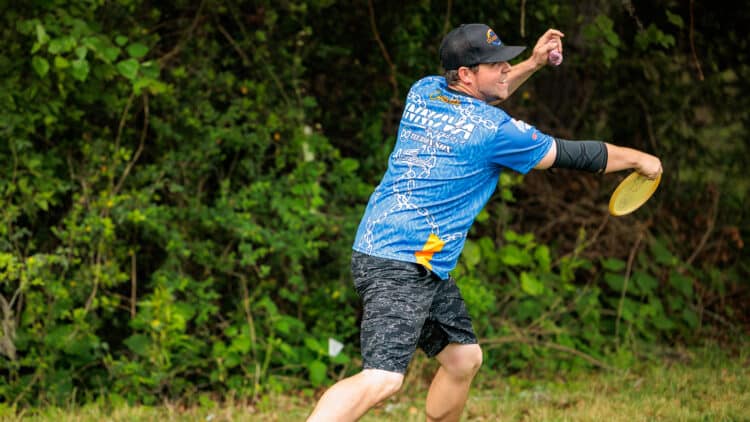
Improving Driving Distance (Beginner-Friendly Guide)
If you’re newer to disc golf (or you’ve been playing a while but still feel “stuck” at the same distance), you’re not alone. The good news: you don’t need a huge run-up or a super overstable driver to throw farther. Most players gain distance by improving clean form, choosing the right disc for their arm speed, and practicing a few simple drills.
Below is a beginner-friendly guide to help you add distance while keeping your throws straighter and more controllable.
1) Start with the right goal: easy distance
A lot of players chase distance by throwing faster discs. But if your arm speed isn’t ready, high-speed drivers tend to:
- Fade hard left early (RHBH)
- Stall out and drop
- Mask form issues (so progress slows)
Instead, aim for smooth, repeatable distance. When your form improves, distance comes along for free.
2) Fix the #1 distance killer: rounding
Rounding happens when the disc swings in a wide arc around your body instead of being pulled in a straight line close to your chest. It usually feels powerful, but it leaks energy.
Quick check
If your disc is far away from your body during the pull, you’re probably rounding.
What to do instead
- Keep the disc on a “rail” close to your chest
- Think: pull straight, then snap
- Keep your shoulders closed a little longer
3) Use your legs and hips (not your arm)
Distance comes from lower-body timing. Your arm is more like the whip at the end.
Key cues
- Plant your front foot firmly (brace)
- Let your hips rotate after the plant
- Keep your head steady and balanced
Simple drill: standstill throws
Do 10–20 throws from a standstill with a midrange or fairway driver. If your distance improves without a run-up, your timing is getting better.
4) Learn nose angle: keep the nose down
If the front edge (nose) of the disc is angled up, the disc climbs, slows down, and fades early.
Signs your nose is up
- The disc rises quickly then dumps left
- You feel like you’re throwing “high” to get distance
Fixes
- Keep your wrist neutral (not curled up)
- Keep the disc level with your forearm
- Aim slightly lower than you think you should
5) Pick discs that match your arm speed
For most beginners and casual players, you’ll get more distance with:
- A neutral midrange for clean release practice
- An understable or neutral fairway/control driver for easy glide
- A distance driver only when you’re consistently turning fairways
Good “distance-building” options from Divergent Discs
- Leviathan (Midrange): Great for learning clean release and getting glide without forcing power.
- Kraken (Control Driver): A controllable driver that can give easy distance when thrown smooth.
- Basilisk (Distance Driver): Best once you’re consistently getting fairways to fly straight with some turn.
If you’re not sure what to throw, start with a fairway/control driver before jumping to max-distance molds.
6) Add snap with a clean release (don’t muscle it)
Trying to throw hard often makes you tense up—and tension kills speed.
Focus on these instead
- Loose arm, strong brace
- Late acceleration (fast at the end, not the beginning)
- Clean release with minimal wobble
Quick drill: towel snap
Use a small towel and practice snapping it late in the motion. You’re training timing, not strength.
7) Practice smarter: one change at a time
If you try to fix everything at once, it’s hard to know what’s working.
A simple practice plan (20–30 minutes)
- 10 standstill throws (midrange)
- 10 slow X-step throws (fairway/control driver)
- 5–10 full-speed throws (only if you’re staying balanced)
Track one metric each session
- Average distance
- How many landed in your “fairway” zone
- How many had clean, wobble-free flight
8) Common beginner mistakes (and quick fixes)
Mistake: throwing the fastest disc you own
Fix: Throw a fairway/control driver until it flies straight with a little turn.
Mistake: big run-up, off-balance finish
Fix: Slow down your footwork; balance beats speed.
Mistake: aiming high for distance
Fix: Keep the nose down and aim flatter.
9) Next step: build a simple distance bag
A beginner-friendly distance setup usually looks like this:
- Putter for clean release and approach
- Neutral midrange for form work
- Understable/neutral control driver for easy distance
- Distance driver only when you’re ready
If you want a simple place to start, build a small bag you can actually learn with—then add speed only when your discs are flying clean and controlled.
Conclusion: distance comes from clean, smooth throws
You don’t need to be a power thrower to add distance. Focus on clean mechanics, nose angle, and discs that match your arm speed—and you’ll see steady progress.
Want easier distance right away?
- Choose a control driver you can throw smooth and straight.
- Keep your practice simple: one change at a time.