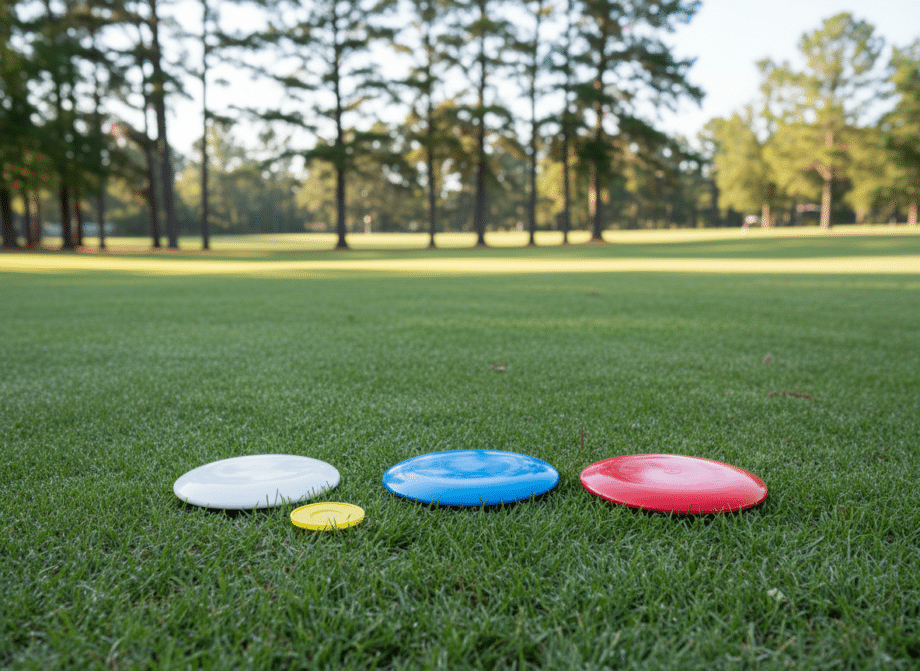

Scoring in disc golf is simple on paper — each throw you make counts as one stroke, and the player with the lowest score at the end wins. In reality, there’s a little more to it than just counting throws. Every shot, whether it’s a drive, an approach, a putt, or even a penalty, adds to your total. Your goal is to finish each hole (and the whole round) in as few strokes as possible, ideally beating both the course par and your competition.
Disc Golf Scoring Terms
Just like in ball golf, disc golf has a set of terms to describe how you did on a hole compared to par:
- Par – The expected number of throws it should take to complete a hole.
- Birdie – Completing the hole one throw under par (e.g., finishing a par 3 in two throws).
- Bogey – Finishing one throw over par.
- Double Bogey – Two throws over par.
- Triple Bogey – Three throws over par.
- Snowman – An informal term for scoring an “8” on a hole, which usually means that hole didn’t go your way at all.
- Eagle – Two throws under par, rare but exciting (more common on par 4s and 5s).
- Albatross – Three under par, incredibly rare in disc golf and something to brag about forever.
- Ace / Hole-in-One – Completing the hole in a single throw. These are much more common in disc golf than in ball golf because most disc golf holes are par 3s and are reachable off the tee.
Scoring Strategies in Disc Golf
While raw skill helps, winning often comes down to making smart choices. Sometimes that means going for the highlight-reel shot, and sometimes it means laying up to avoid adding strokes. For example:
- Lay Up to Avoid a Three-Putt – If you’re outside your comfortable putting range, or if the basket is located on hills, high winds or water hazards in the backgroung, it’s often smarter to throw a controlled upshot and take the easy putt for par than to risk running past the basket and missing the comeback putt.
- Risk vs. Reward on Tight Gaps – Imagine you’re on the tee and there’s a narrow gap of trees that, if hit perfectly, could set you up for a birdie. But if you hit an early tree, you’re likely staring down a bogey. The safer option might be to aim for a wide-open fairway route that guarantees an easy up-and-down for par.
- Play the Conditions – In windy or wet conditions, aggressive shots are riskier. Sometimes “boring golf” is the winning golf.
- Know Your Strengths – If forehands aren’t your thing, don’t force them just because it’s the “ideal” shot for the hole. Play the shot you can execute consistently.
The players who manage risk well often outperform technically better throwers. Disc golf is as much about decision-making as it is about throwing ability.

Keeping Track of Your Score
Once you understand scoring, you’ll need a way to keep track of it. Here are the main options:
- Over/Under Par in Your Head – The simplest method. Just keep a running tally of how many strokes over or under par you are. Works best for casual rounds and small groups.
- Disc Golf Apps – The free Infinite Discs Scorekeeping App makes it easy to log scores, track stats, and review past rounds. It’s especially handy for league play or tracking personal improvement.
- Printable Scorecards – Great for tournaments, casual rounds with friends, or for people who prefer a physical record. Many courses have scorecards available, or you can print your own ahead of time.
Download a PDF disc golf scorecard here.
No matter which method you choose, agree on scores with your group after each hole to avoid confusion later.
In the end, scoring in disc golf is all about minimizing mistakes, taking calculated risks, and knowing when to play it safe. Keep your head in the game, and those birdies will add up faster than you think.