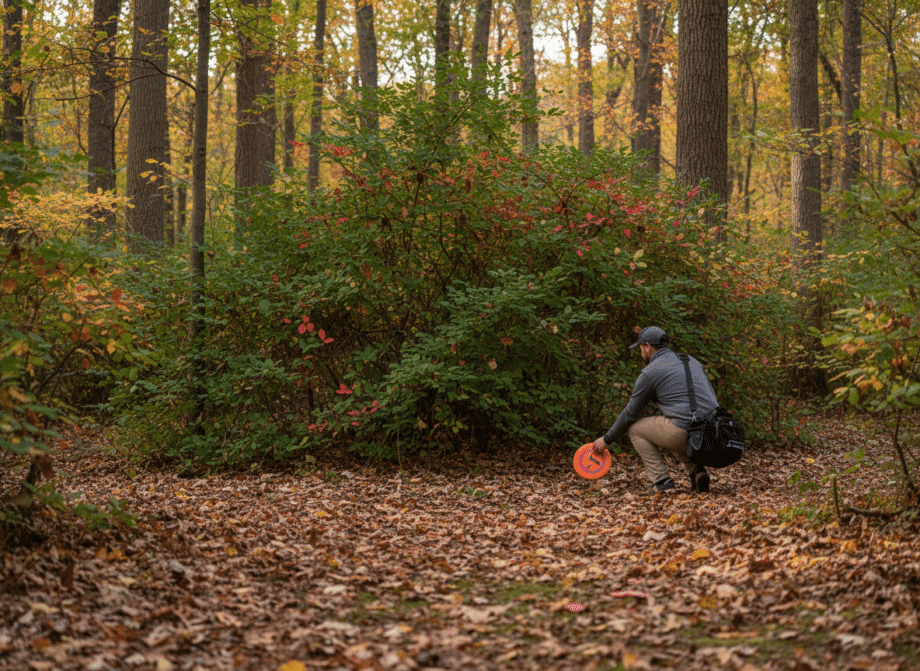

If you’re brand new to disc golf, don’t worry — you don’t need to memorize the entire rulebook (it’s actually pretty long) before heading out to play. You just need a handful of core rules so you can keep the game moving, stay fair, and have fun. Here’s the beginner-friendly version of the basic rules in disc golf.
1. Teeing Off
Each hole starts with a throw from the tee pad (or marked tee area). The player with the lowest score on the previous hole throws first. On the very first hole, you can pick the order however you like — coin flip, best player first, or “whoever’s ready.”
2. Marking Your Lie & Planting Your Foot
After your throw, you’ll make your next shot from the spot where your disc landed. You have to keep your plant foot on or within an imaginary rectangle the size of a piece of paper that’s 20cm (about 8 inches) wide and 30cm (about 12 inches) deep directly behind the front edge of your disc. Your other foot can be anywhere as long as you keep balance when you throw.
If you want to throw the same disc you just used, you can mark your lie with a mini marker disc. Just place the mini right in front of your disc (toward the basket), touching it. Then pick up your thrown disc and throw from behind the mini.
3. Throw Order
After everyone tees off, the player farthest from the basket always throws next, no matter who threw first. On the next tee, the player with the lowest score on the previous hole throws first. If two or more players tied on that hole, their tee order stays the same as it was before. In casual rounds, this is more about etiquette than a strict rule — a lot of people just play “ready golf,” where players tee off as soon as they’re ready instead of waiting for an official order.
4. Out of Bounds (OB) & Last Point in Bounds
If your disc lands clearly out of bounds — in a pond, over a fence, or past a marked line — you take a one-throw penalty. You then play your next shot from the point where your disc was last in bounds. Picture an invisible vertical “aerial plane” rising up from the OB line; your spot is where your disc last crossed back into that in-bounds space, not where it eventually landed.
5. Scoring
Disc golf scoring works just like ball golf — fewer throws is better. Each hole has a “par” number. You can keep track of your score a few ways:
- Just remember how many throws you’re over or under par in your head. This is pretty easy if you get par on most holes, but, when you’re new and shoot well over par, this is not the recommended method.
- Use a free Disc Golf Scorekeeping App.
- Write it down on a paper scorecard. You can print out one of these PDF Disc Golf Scorecards to use. For best performance, use thick paper or cardboard.
Whatever works for you is fine as long as everyone in your group agrees on scores at the end of each hole.
6. Putting & The Circle
In PDGA rules and common disc golf terminology, the “circle” is the 10-meter (about 33 feet) area around the basket. If your disc is inside this area, you must keep your balance and cannot step past your lie until after the disc comes to rest in the chains or basket. Some greens are tighter than 10 meters, especially when baskets are tucked into wooded corners, and there can still be plenty of obstacles even inside the circle.
7. Completing the Hole
A hole is only complete when your disc comes to rest supported by the basket tray or chains. Discs on top of the basket don’t count — that’s called a “spit out” or “drop-in fail” and yes, it’s frustrating.
That’s it — those are the essentials. Keep them in mind, and you’ll be playing fair and having a great time. And remember, the most important rule in casual disc golf is: have fun and keep it moving!
Want a printible version of the basic rules. Here’s a quick basic disc golf rules cheat sheet.