
Disc Flight Numbers – Turn (What It Means and How to Use It)
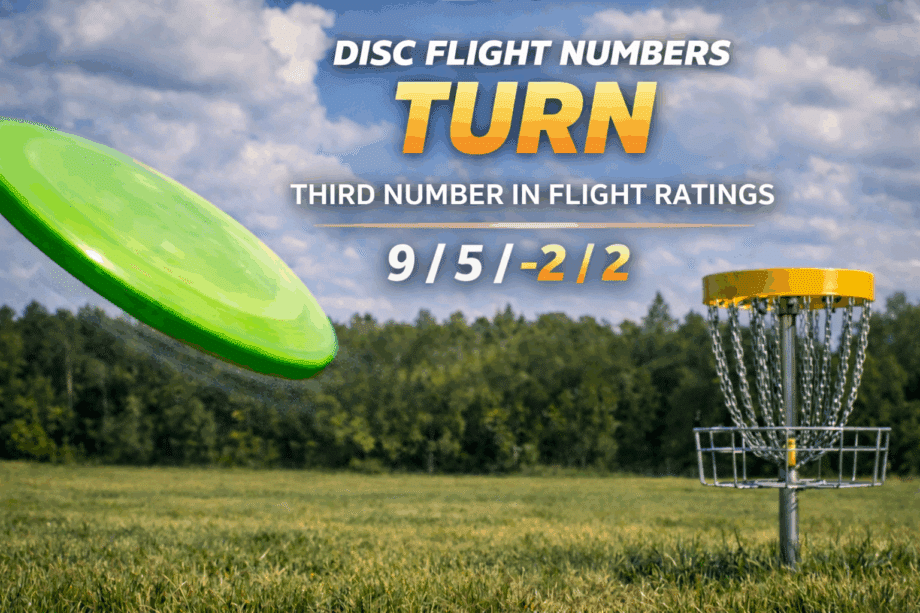
Turn is the third number in disc golf flight ratings, and it describes what the disc wants to do during the high-speed part of the flight (right after release).
Example: 9 / 5 / -2 / 2 → the -2 is the disc’s turn.
For a right-hand backhand (RHBH) throw, turn is the disc’s tendency to drift to the right early in the flight. (For left-hand backhand, it’s the opposite.)
Typical Turn Number Range (And What Each Range Usually Means)
Turn is most commonly shown from 0 to -5 (with +1 appearing occasionally on some molds).
Turn = 0
- Minimal high-speed turn
- More resistant to drifting right early (RHBH)
- Often feels more predictable for newer players who tend to release with wobble
Turn = -1 to -2
- Moderate turn
- Often the “sweet spot” for easy straight flights for many casual players
- Great for learning controlled distance without needing max power
Turn = -3 to -5
- High turn (more understable behavior)
- Easier to flip up from hyzer (hyzer-flip style shots)
- Can drift right a lot early in flight (RHBH), especially in wind
Turn = +1 (Rare)
- Strongly resists turning during the high-speed portion of flight
- Usually paired with noticeable fade
Why Turn Matters for Beginners (And “Normal Arm Speeds”)
Turn is one of the biggest reasons a disc feels “easy” or “hard” to throw straight. Many beginners don’t generate the same speed as advanced players, so a disc with a little turn can help the disc:
- Stand up to flat instead of fading early
- Carry straighter down the fairway
- Get more usable distance without throwing harder
If a disc has too little turn for your current speed, it may feel like it “always goes left” (RHBH) because fade kicks in early.
Turn vs. Fade: How They Create Your Shot Shape
Turn happens early. Fade happens late. Together, they create the overall flight pattern.
Common Flight Shapes (RHBH)
- More turn + moderate fade = classic “S-curve” distance flight
- More turn + low fade = long drifting right flights
- Low turn + strong fade = dependable left finish
Wind Tip: Headwinds Increase Turn
A headwind makes a disc behave more understable. That means a disc with turn can turn more than expected in a headwind.
Quick fixes for windy days
- Choose a disc with less turn (closer to 0)
- Throw smoother and focus on a clean release
- Learn wind basics here: How Does Wind Affect Your Throws?
Common Turn Problems (And How to Fix Them)
“My Disc Turns and Burns Into the Ground” (RHBH)
If your disc quickly turns over and dives right, it can be caused by too much turn for your power, a nose-up release, wobble (off-axis torque), or a strong headwind.
Try this
- Move to a disc with less turn (closer to 0)
- Power down and focus on a clean, smooth release
- If it’s windy, club up to something more stable
“My Disc Never Turns—It Just Fades Left” (RHBH)
If everything finishes left, the disc may be too stable for your current speed.
Try this
- Try a disc with more turn (more negative)
- Consider a lighter weight or a beginner-friendly mold
Shop Discs That Match Your Arm Speed
If you want discs designed to be easier to throw for real-world arm speeds, these pages make shopping simple:
Beginner-Friendly Examples
If you’re looking for a “first driver” style disc that’s built for newer players, check out the Tiyanak (Beginner Driver). For controlled, useful flights without needing big power, many players also like easy-to-throw mids such as the Kapre Midrange or Leviathan Midrange.
Final Takeaway: Turn = Early Flight Drift
Turn tells you what a disc wants to do during the fast part of flight. For many beginners, a little turn is a good thing—it helps discs fly straighter and farther with less effort.