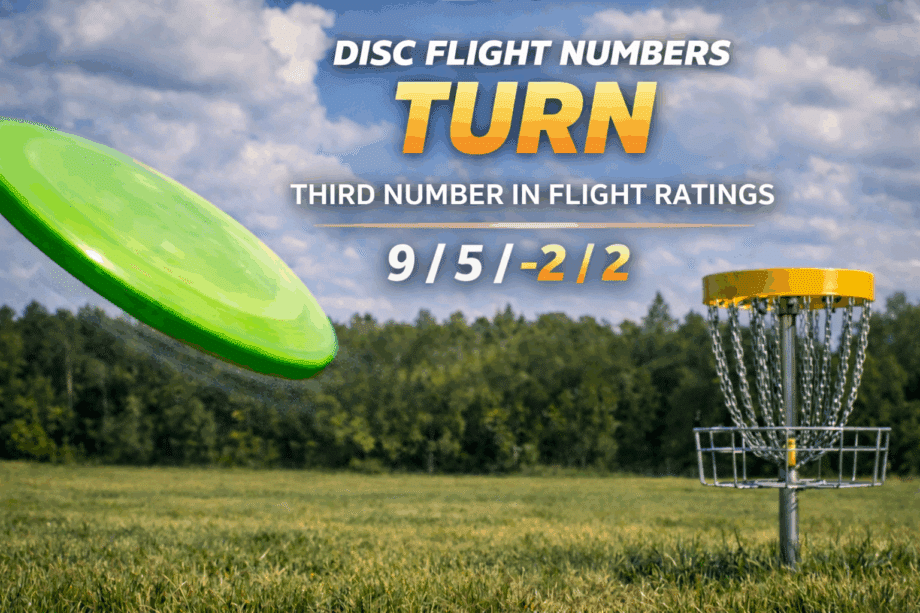

Disc Flight Numbers – Fade (What It Means and How to Use It)
Fade is the fourth number in disc golf flight ratings, and it describes how the disc finishes at the end of its flight as it slows down.
Example: 9 / 5 / -2 / 2 → the 2 is the disc’s fade.
For a right-hand backhand (RHBH) throw, fade is the disc’s tendency to finish to the left at the end of the flight. (For left-hand backhand, it’s the opposite.)
Typical Fade Number Range (And What Each Range Usually Means)
Fade is most commonly shown from 0 to 5.
Fade = 0–1 (Minimal Finish)
- Finishes straighter with less “hook” at the end
- Often easier for beginners to keep on the fairway
- Great for straight shots and gentle landings
Fade = 2–3 (Reliable Finish)
- Noticeable, dependable finish at the end of flight
- Good balance of control and predictability
- Useful for consistent shot shapes
Fade = 4–5 (Strong Finish)
- Hard, strong finish at the end of flight
- Often helpful in wind (especially paired with low turn)
- Can create bigger skips depending on angle and ground
Why Fade Matters (Even If You’re New)
Fade is what makes a disc predictable at the end of the flight. Even if you don’t throw far yet, fade helps you plan where the disc will land.
If you’re newer and it feels like your disc “always dumps left” (RHBH), you may be throwing a disc with too much fade (or too much stability) for your current speed.
How Fade Shows Up on the Course
Fade Happens Late
Fade shows up most when the disc slows down. That’s why two players can throw the same disc and see different results: the faster thrower may see more turn first, while the slower thrower may see fade earlier.
Fade Helps You Shape Reliable Lines
- Finishing around obstacles
- Landing safely away from trouble
- Throwing consistent hyzers
Fade Can Affect Ground Play (Skips and Slides)
A disc fading hard into the ground at an angle may skip more, especially on short grass or hard-packed dirt. If you want less ground play, consider lower fade or a disc designed to sit down quickly.
Common Fade Problems (And How to Fix Them)
“My Disc Always Fades Left Too Early” (RHBH)
This usually happens when the disc is too stable for your speed, or when it’s thrown nose-up.
Try this
- Choose a disc with lower fade and/or more turn
- Throw smoother and focus on keeping the nose down
- Learn the basics of stability here: Understable vs. Overstable
“My Disc Doesn’t Fade—It Just Keeps Turning”
If your disc drifts right and never comes back (RHBH), you may be using too much turn, throwing into a headwind, or releasing with too much anhyzer.
Try this
- Try a disc with more fade (or less turn)
- Reduce anhyzer angle and focus on a clean release
- If it’s windy, choose a more stable option
Shop Discs by Type
Want a disc that finishes straighter, or one that finishes harder? Start with the category that matches the shot you’re trying to throw:
- Putt & Approach Discs (great for controlled finishes)
- Midrange Discs (often the easiest category to learn clean fade)
- Drivers (bigger fade differences, especially at higher speeds)
- Shop by Throwing Distance
Examples of “Finish” Styles
If you want a disc that’s designed to sit down and reduce big skips/rollaways, many players like silicone-style approach options such as the Alpas or utility options like the Golem. If you’re looking for more driver-style finishes, explore the driver lineup here: Divergent Drivers.
Final Takeaway: Fade = The Finish
Fade tells you how strongly a disc wants to finish as it slows down. If you want straighter finishes, choose lower fade. If you want a dependable left finish (RHBH), choose higher fade.