
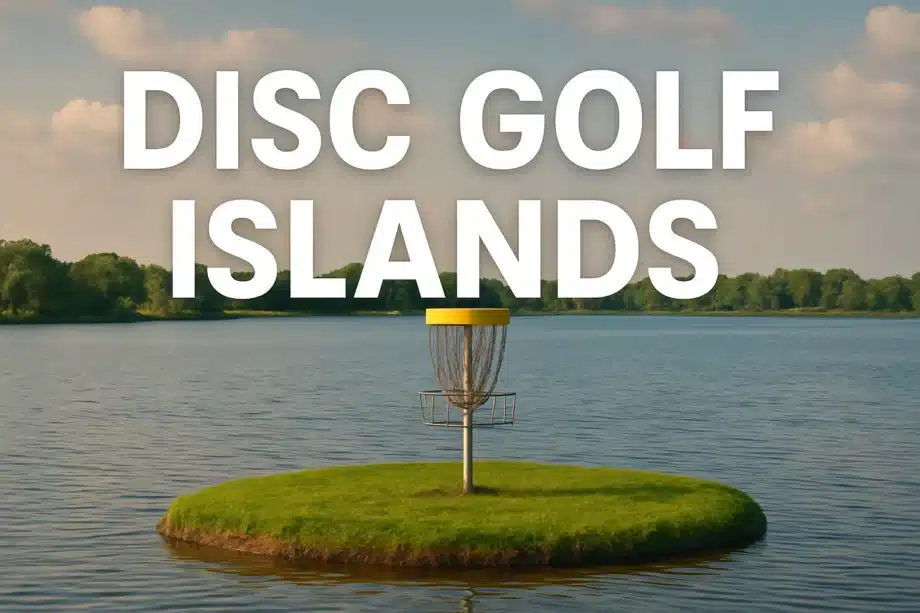
Ever thrown the perfect shot, only to realize it was just a hair outside the “Island”? Yep, welcome to the mental rollercoaster that is disc golf’s most deceptive challenge.
Imagine trying to land a paper airplane on a dinner plate from across the room. That’s pretty much what an Island hole in disc golf feels like—except you only get one shot, and if you miss, things can get messy fast. In this post, we’re breaking down what Island holes really are, why they exist, and how they can make or break your round.
We’ll look at:
- What an Island really is in disc golf
- How Island OB is different from regular OB
- Why the drop zone rule matters
- What happens when there is no drop zone
- How pros have been burned by Island holes
- Tips to survive the Island madness
Island Holes Aren’t Always Surrounded by Water
Despite the name, most Island holes aren’t on actual islands. In fact, there’s rarely a lake in sight. Instead, the “Island” is an imaginary area marked off by ropes, sidewalks, hay bales, bricks, rocks, or other OB indicators.
The key difference? Unlike normal OB, where your disc can land inbounds and then roll out, with an Island, your disc must land inside the marked zone. If it doesn’t, you’re considered out of bounds, no matter how close it was.
Pro tip: Always check the course map or hole sign before you throw—some Islands are sneakier than others.
Island OB vs. Regular OB: Know the Difference
Here’s where things get spicy. Most OB rules let you take your next shot from where the disc went out, plus a penalty stroke. But with Islands, you usually have to go to a drop zone—a designated spot where you’ll re-throw with a stroke penalty.
This setup makes Island holes high-risk, high-reward. They test your accuracy, nerves, and decision-making in one tidy package.
Stat check: According to UDisc Live stats, Island holes often average a full stroke higher than similar-length non-Island holes.
No Drop Zone? Things Get Brutal
Some courses take things even further. If there’s no drop zone provided, and you miss the Island, guess what? You’ve got to re-tee. Again. And again. And again… until you finally land in bounds.
Oh, and here’s the kicker—you can’t rethrow the same disc you just used. According to PDGA rules, you must throw a different disc. That means your top choice is gone, and now you’re scrambling to find a backup you trust just as much.
Tip: Keep multiple discs in your bag that you’re confident throwing for tight landing zones. Don’t rely on just one Island hero.
When Islands Ruin Tournaments
Island holes have wrecked the scorecards—and dreams—of many a disc golfer. One of the most famous examples? JohnE McCray’s meltdown at the USDGC. He repeatedly missed the Island and had to rethrow, stacking up penalty strokes that knocked him out of contention.
This kind of disaster is exactly why the PDGA stepped in. Now, courses are required to offer a drop zone to give players at least a fighting chance if they miss the Island on their first try.
“There’s no heartbreak quite like missing the Island and watching your disc skip just inches away.” — Nate Sexton
Surviving Island Holes: Strategy Over Power
So how do you beat the Island game? It’s not just about raw power—it’s about strategy. Choose a disc you know will stick the landing, even if it means sacrificing distance. Play smart, not reckless.
Practice controlled approaches and learn the wind. And most importantly, never let one bad Island shot ruin your round.
Remember: Everyone has a horror story. What separates the winners is how they recover.
Final Thoughts: Respect the Island
Island holes in disc golf are like mini-bosses—they demand precision, punish recklessness, and reward the bold. Whether marked by bricks, rope, or bales of hay, they test your mental game just as much as your throwing arm.
By understanding how they work, preparing the right discs, and staying cool under pressure, you can walk off the Island with your head held high—and maybe even a birdie on the card.
Play smart. Stay in bounds. And never underestimate the Island.